
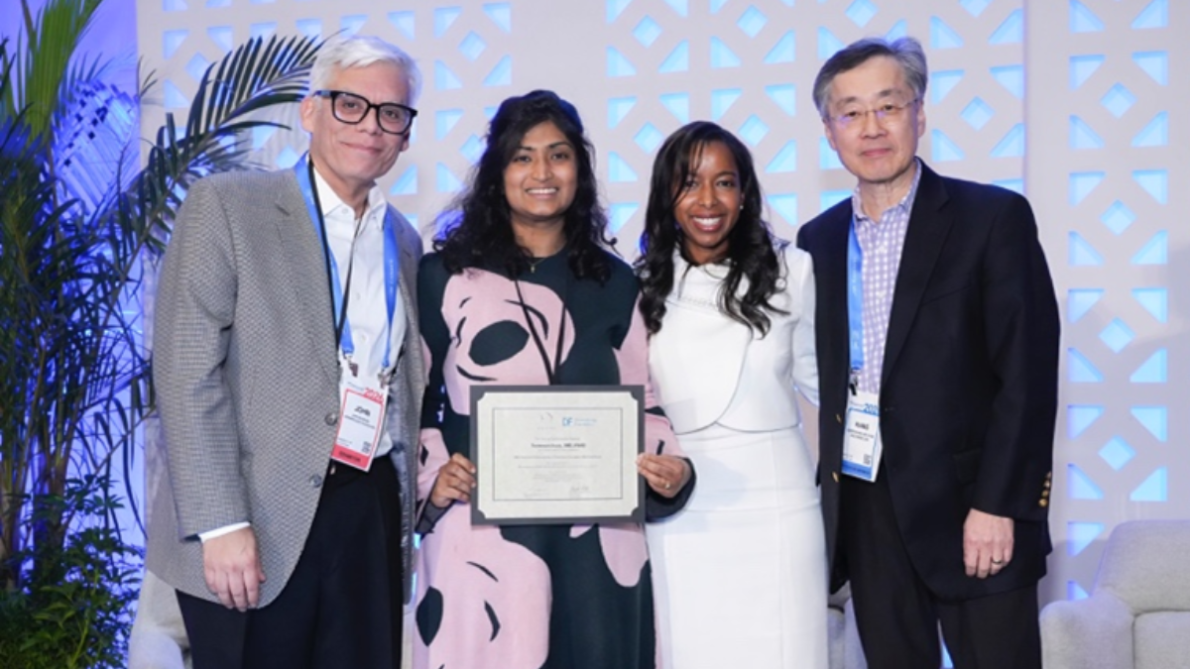
Tarannum Jaleel, MD, MHSc, assistant professor of dermatology, recently received the Dermatology Foundation-Skin of Color Society (SOCS) Collaborative Mid-Career Research Award and the SOCS Institutional Research Fellowship Grant, both awarded at the SOCS Scientific Symposium and Dermatology Foundation reception in Denver.
The Mid-Career Research Award provides a $100K grant in annual support for up to three years to support the work of outstanding investigators with an established trajectory of excellence in basic, clinical, or translational science. The supported research projects are expected to yield novel results that expand the understanding of dermatological issues in skin of color.
The Institutional Research Fellowship Grant provides $40K to support a researcher with an interest in skin of color dermatology and/or health equity research. This opportunity enables an early-career physician fellow to investigate dermatologic conditions that need more scientific research in skin of color and to prepare for leadership roles in clinical care, public policy, health services research, and biomedical research. As part of this grant, Duke Dermatology will welcome Ikenna Anusionwu, MD, MBE, as a new Skin of Color research fellow in July; Anusionwu will join the department’s efforts to advance equity-focused dermatologic care and research.
Jaleel specializes in research and clinical care of hidradenitis suppurativa (HS), a chronic inflammatory skin condition. She leads an integrated program examining how hormone signaling and gene expression modulate skin inflammation in HS, with the goal of identifying novel biomarkers and therapeutic targets. This research is supported by Jaleel’s NIH BIRCWH K12 award, a Physician‑Scientist Strong Start Award from the Duke University School of Medicine, and grants from the Dermatology Foundation, the Skin of Color Society, and Duke’s Precision Genomics Collaboratory.
Jaleel has also led multiple phase 1–3 clinical trials of emerging systemic therapies and cellular CAR-T based therapies, helping expand access to innovative treatment options for patients with moderate to severe HS.
Her scholarship spans the burden and biology of HS, including work on cardiometabolic comorbidities, pain, musculoskeletal symptoms, quality of life, and the overlap between HS and other inflammatory skin diseases such as atopic dermatitis. Jaleel has also contributed to national efforts to modernize population descriptors and advance inclusive skin color classification in dermatology research.
Together with associate professor of dermatology Sarah Wolfe, MD, Jaleel co-mentors Duke’s Skin of Color Clinical and Research Fellowship, which has created a strong pipeline for training fellows, residents, and students in HS care, clinical investigation, and health-equity scholarship.
“I am grateful for this support, which will allow our team to pursue new strategies for understanding and treating hidradenitis suppurativa and to help train the next generation of clinicians and scientists focused on skin of color.”
— Tarannum Jaleel, MD, MHSc