
Access can sound like an operational challenge, mostly connected to appointments, capacity, schedules, and lead times. But for a patient waiting to learn if a concerning skin lesion is cancer, access is something much more personal. And sometimes, solving an access problem can create a better experience not only for patients, but also for the clinicians caring for them.
That is what makes Duke Dermatology’s “Midi” and “Mega” Clinics such a meaningful model: patients get the care they need sooner, clinicians get to work side-by-side in a way that feels energizing and deeply connected to purpose, and the team creates more capacity without losing the thoughtful, expert care patients deserve.
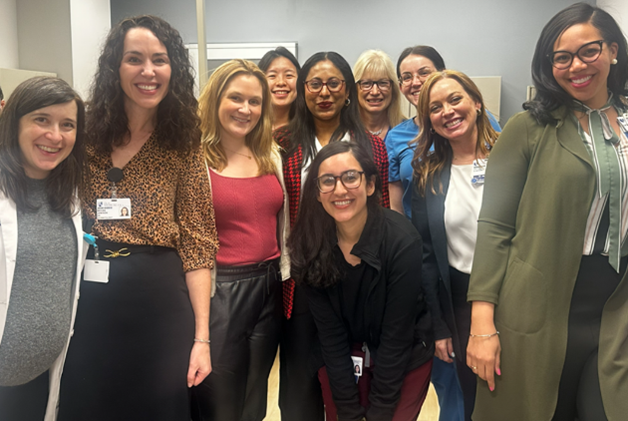
The model was conceived by Matilda Nicholas, MD, PhD, vice chair for clinical operations in the Department of Dermatology, and has been developed by faculty, residents, clinical teams, and staff across Duke Dermatology. Earlier this year, Samantha Polly, MD, Megan O’Brien Jamison, MD, and residents Carolyn Ahlers, MD, Morgan Brazel, MD (now faculty), Emily Granger, MD, Eman Hijab, MD (now an alumna), and Jeremy Martinez, MD, were among those who helped bring a Mega Clinic to life, with the team continuing to refine the approach along the way.
This summer, that work produced striking results.
Across two afternoon clinics on July 31 and August 7, the team cared for 74 patients, 71 of them new to Duke Dermatology. Clinicians diagnosed 10 non-melanoma skin cancers and two melanomas, treated three large and symptomatic benign growths, and identified two patients with insulin resistance so they could get the additional care they needed.
Those results are remarkable and worth celebrating. In just two afternoons, dozens of patients gained faster access to care, serious diagnoses were made, and people who had been waiting for answers were able to begin moving forward. But even that impact tells only part of the story.
For Nicholas, what has been just as striking as the impact on patients is what the clinics have created for the people delivering the care. “We started this because patients needed to see us sooner, but it has been incredibly rewarding to see what it has created for our team, too,” Nicholas said.
“There is an energy that comes from a team who might not normally be working together, with everyone in the same space and a shared purpose, knowing that the patient in front of you might otherwise have waited months for that care. You can feel the impact on all our pillars — education, innovation, and patient care — while you’re doing the work.”
— Matilda Nicholas, MD, PhD
What happened inside these clinics was just as meaningful: clinicians, residents, and support teams working side by side, at pace and with purpose, in a way that made the work feel collaborative, energizing, and deeply connected to why they chose it.
“Midi Clinic has without a doubt been one of the top clinical memories of Dermatology residency,” said Carrie Diamond, MD, a third-year dermatology resident. “We have been able to expedite the diagnosis and treatment and care for patients who otherwise would have been stuck on long waiting lists with an onerous delay in diagnosis.”
For Paul Shim, MD, a second-year dermatology resident, the Mega Clinic struck a similarly powerful balance. He called it “easily among the best clinics at Duke,” citing the combination of high volume, efficient visits, and the ability to care for patients with complex, high-acuity dermatologic needs. “Very satisfying to provide care for so many patients who desperately need it,” Shim said, adding that the model is only possible because of “such a great team, including the attendings and support staff.”
Martinez, a second-year dermatology resident, described the Midi and Mega Clinics as “truly outstanding,” saying, “It is a joy to be able to deliver prompt, much-needed care to patients in a fast-paced clinical setting.” He also credited the people around him for making that experience possible: “I am grateful to the attending, residents, and support staff who make this all possible.”
Taken together, those experiences point to something bigger than a successful clinic model.
“This is the kind of work we should pay attention to,” said Matthew Barber, MD, MHS, MSOD, senior vice president of ambulatory services and physician practices in the Duke University Health System and president of Duke Health Integrated Practice.
“Patients are getting the care they need sooner, and at the same time, our clinicians are telling us that the work feels collaborative, energizing, and meaningful. When we can make care work better for the patient and make it easier for our people to do the work they came here to do, that is a real win — and something we should learn from.”
— Matthew Barber, MD, MHS, MSOD
For the patients who received a cancer diagnosis sooner, found relief from a painful condition, or avoided a longer wait for answers, that impact was immediate and deeply personal. For the clinicians who delivered that care, it was a reminder of what becomes possible when the system supports them in doing meaningful work together.
The Midi and Mega Clinics offer a powerful example of what is possible when clinicians, staff, and leaders are empowered to rethink how care is delivered and work together around the people who need us.
This is Duke Health at our best: when the mission comes to life for patients, for clinicians, and for the teams who make both possible.
This article was originally published on the Duke University Health System intranet.